
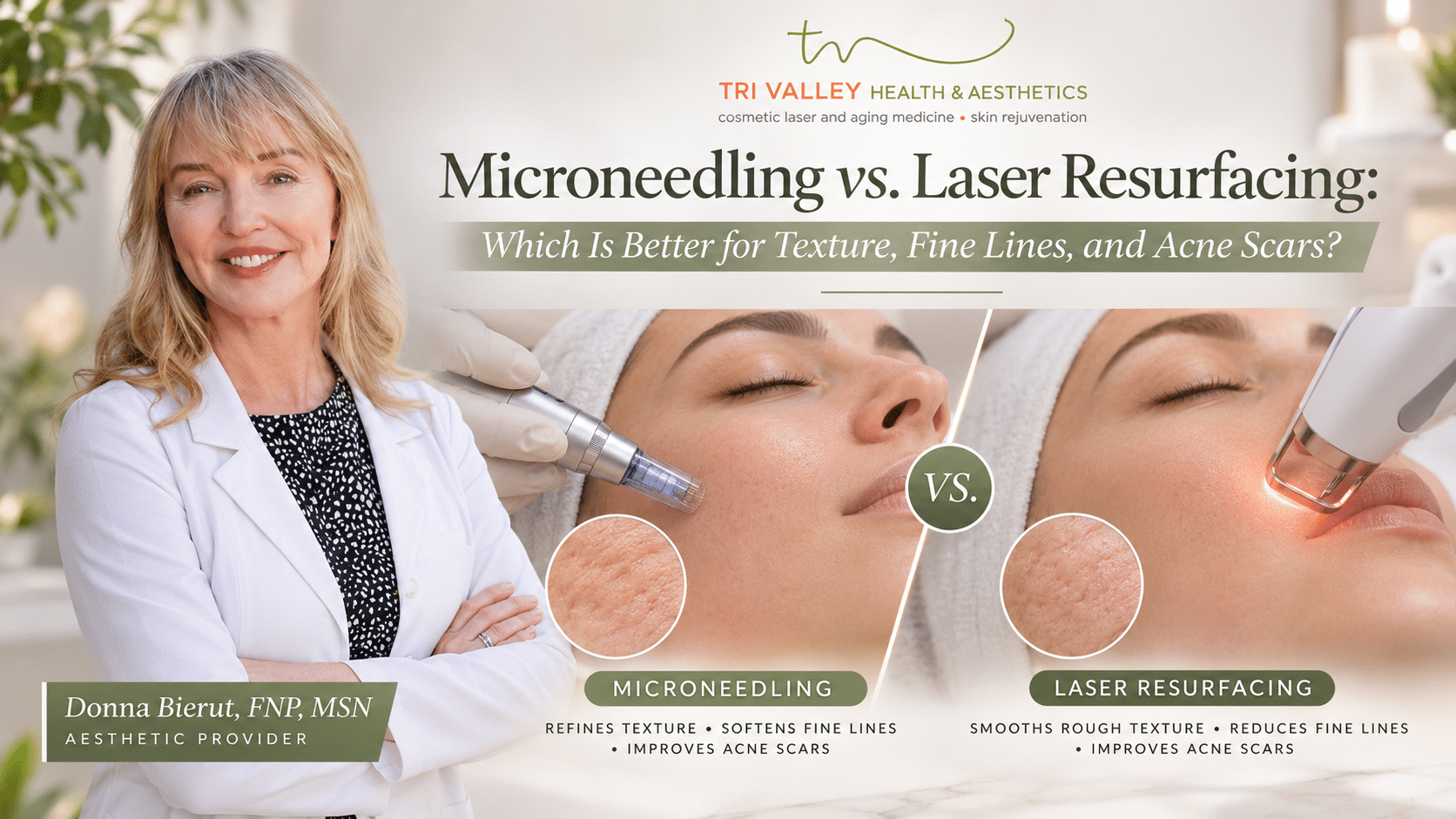
Microneedling and laser resurfacing are both used in skin-rejuvenation planning, but they do not work the same way. Medical-grade microneedling creates controlled microchannels with fine needles, while laser resurfacing uses focused light energy to create a controlled treatment effect in selected skin layers or targets. Which option makes more sense depends on the concern being treated, your skin characteristics, how much recovery you are comfortable with, and the specific device or treatment depth being considered.
That distinction matters most for acne scars, uneven texture, and fine lines. The American Academy of Dermatology (AAD) lists both microneedling and laser treatment among procedures dermatologists may use for acne scars. Current comparative research also supports an individualized approach rather than a universal winner.
Quick Answer
Microneedling uses controlled needle punctures to stimulate skin remodeling, while laser resurfacing uses focused light and thermal energy to create a controlled treatment effect. Both may be considered for texture, fine lines, or acne-scar concerns. The better fit depends on scar type, skin tone, treatment depth, pigmentation risk, expected downtime, and your goals.
In This Guide
- The Quick Difference: Needles vs. Light / Heat
- What Medical-Grade Microneedling Can Address
- What Laser Resurfacing Can Address
- Microneedling vs. Laser Resurfacing for Acne Scars
- Which Usually Involves More Downtime?
- Skin Tone and Pigment-Risk Considerations
- Can Microneedling and Laser Treatments Be Combined?
- How to Choose in Coeur d’Alene
- Frequently Asked Questions
- Resources
The Quick Difference: Needles vs. Light / Heat
The simplest way to understand the comparison is mechanical stimulation versus light-based resurfacing. Standard medical microneedling creates tiny channels with needles. Laser resurfacing creates controlled heat or ablation using a laser, and the depth and recovery can vary widely depending on the technology and settings.
Primary mechanism
- Medical-Grade Microneedling: Controlled microchannels / mechanical stimulation
- Laser Resurfacing: Focused light / thermal energy; device-dependent
Often discussed for
- Medical-Grade Microneedling: Texture, fine lines, selected scars
- Laser Resurfacing: Texture, sun damage, wrinkles, selected scars; laser-dependent
Recovery profile
- Medical-Grade Microneedling: Often more limited with standard microneedling, but varies
- Laser Resurfacing: Ranges from modest to more significant depending on wavelength, depth and settings
Pigment planning
- Medical-Grade Microneedling: Still requires individualized assessment
- Laser Resurfacing: Skin type, wavelength, depth and pigment risk require careful selection
Best fit
- Medical-Grade Microneedling: Depends on concern, scar type, skin characteristics and goals
- Laser Resurfacing: Depends on concern, scar type, skin characteristics and goals
What Medical-Grade Microneedling Can Address
The U.S. Food and Drug Administration (FDA) describes microneedling devices as instruments with many small needles, tips, or pins that repeatedly enter and leave the skin to create small puncture holes. FDA-authorized uses for certain devices include improving the appearance of facial acne scars and facial wrinkles in adults 22 and older.
The AAD also describes microneedling as a collagen-induction treatment used for concerns such as acne scars, uneven texture and tone, and fine lines. That does not mean every person with those concerns is automatically a candidate. Device selection, treatment depth, medical history, active skin conditions, medications, and expectations still matter.
At Tri Valley, the current medical-grade microneedling page describes a standard automated microneedling treatment rather than radiofrequency microneedling. That distinction is important because RF microneedling adds energy below the skin and has a different risk and evidence profile. This article therefore does not treat standard microneedling and RF microneedling as interchangeable.
What Laser Resurfacing Can Address
“Laser resurfacing” is a broad category, not a single procedure. Different lasers can be ablative or non-ablative, fractional or non-fractional, and designed to reach different depths or targets. Those differences affect what a treatment may address and how much recovery may be involved.
Tri Valley currently lists multiple laser and light-based treatments, including Fraxel laser therapy and CO₂ resurfacing. Fraxel is a fractional laser platform, while CO₂ resurfacing is a different form of laser resurfacing that can be delivered at different treatment depths. The exact Fraxel model, wavelength, treatment intensity, and recovery plan should be confirmed during consultation rather than assumed from the brand name alone.
For acne scars specifically, the AAD notes that dermatologists use lasers to resurface scarred skin and stimulate remodeling as it heals. The appropriate laser depends on scar type, skin characteristics, and the treatment plan.
Microneedling vs. Laser Resurfacing for Acne Scars
For acne scars, the evidence does not support a one-size-fits-all answer. Both microneedling and fractional laser approaches can improve the appearance of atrophic acne scars, but the tradeoffs are different.
A 2026 systematic review and meta-analysis comparing fractional CO₂ laser with needling-based procedures found no significant difference in pooled mean scar-score reduction, although categorical treatment success favored fractional CO₂ laser in the included evidence. The same review found a higher risk of post-inflammatory hyperpigmentation with fractional CO₂ laser than with standard microneedling. The authors emphasized that skin type, scar type, and complication risk should influence treatment selection.
A smaller 2024 split-face study in skin of color also found both microneedling and fractional CO₂ laser improved atrophic acne scars, while the laser side showed greater improvement but more post-procedure hyperpigmentation. Because that study was small and specific to its protocol, it should not be used to predict an individual patient’s result.
The practical takeaway is not that one treatment “wins.” If scar remodeling is the main priority, a provider may discuss more intensive resurfacing. If recovery time or pigment risk is a major concern, standard microneedling may deserve a different place in the conversation. Scar morphology also matters: rolling, boxcar, and ice-pick scars do not necessarily respond the same way to the same treatment.
Which Usually Involves More Downtime?
Standard microneedling is generally discussed as a minimally invasive procedure, but “minimal” does not mean “no downtime.” The FDA lists common short-term effects such as redness, tightness, peeling, bruising, bleeding, discomfort, and crusting. Some people may need more than one session, and recovery varies with device depth and individual response.
Laser recovery varies even more because “laser resurfacing” covers multiple treatment depths and technologies. A light fractional treatment may have a very different recovery profile from a more intensive ablative CO₂ treatment. For that reason, fixed recovery promises should be avoided until the exact device, settings, and treatment plan are known.
Skin Tone and Pigment-Risk Considerations
Skin tone should be part of treatment planning, not an afterthought. The AAD notes that microneedling can be used across skin tones, while the FDA still cautions that pigmentation changes can occur and that some authorized devices were not studied in darker skin types.
With laser resurfacing, wavelength, treatment depth, recent sun exposure, and a history of post-inflammatory hyperpigmentation can influence risk. Comparative acne-scar evidence has reported more pigment change after fractional CO₂ laser than after standard microneedling in some study populations. That is one reason consultation should include Fitzpatrick skin type, prior pigment changes, current tanning or sun exposure, and the expected treatment intensity.
Can Microneedling and Laser Treatments Be Combined?
Microneedling and laser resurfacing may appear in the same longer-term skin-rejuvenation plan, but that does not mean they should automatically be performed together or on the same day. Sequence, spacing, and treatment depth should be determined by the provider based on the goal, how the skin responded to prior procedures, and the recovery profile of each treatment.
The FDA also notes that the risks of some off-label microneedling uses and combinations have not been established. That supports a cautious approach: combination planning should be specific to the patient and the actual devices or products being used, rather than copied from a generic online protocol.
How to Choose in Coeur d’Alene
If you are comparing treatments in Coeur d’Alene, start with the concern rather than the device name. Tri Valley can evaluate whether medical-grade microneedling, laser treatments in Coeur d’Alene, Fraxel laser therapy, CO₂ resurfacing, or another approach fits the discussion.
A consultation should cover your skin history, scar or texture pattern, prior treatments, pigment history, sun exposure, recovery preferences, and realistic expectations. You can also review the broader medical spa in Coeur d’Alene approach before you schedule a consultation.
Frequently Asked Questions
Is microneedling better than laser resurfacing for acne scars?
Not universally. Both can improve atrophic acne scars. Comparative evidence suggests some fractional CO₂ protocols may produce greater improvement in selected patients, while standard microneedling may involve different recovery and pigment-risk tradeoffs. Scar type, skin tone, treatment intensity, and your priorities matter.
Which treatment usually has less downtime: microneedling or laser resurfacing?
Standard microneedling often has a more limited recovery profile than more intensive ablative laser resurfacing, but there is no single downtime number. Laser recovery varies substantially by wavelength, depth, settings, and treatment area, while microneedling recovery varies by depth and individual response.
Can microneedling and laser resurfacing be used in the same treatment plan?
They may be considered as part of a staged plan, but timing and sequence should be individualized. A provider should determine whether combining modalities makes sense for your skin and how much time should separate treatments.
Which is better for fine lines and skin texture?
Both may be considered. Microneedling supports collagen remodeling through controlled mechanical injury, while fractional lasers use light and heat to create a controlled resurfacing effect. The better fit depends on the depth of the concern, skin characteristics, recovery tolerance, and the exact device being considered.
Is one option better for darker skin tones?
Microneedling is often discussed as a useful option across skin tones, but pigment changes are still possible. Laser treatment can also be used in many skin types, but wavelength, depth, settings, and a history of hyperpigmentation require careful selection. An in-person assessment is more useful than choosing based on skin tone alone.
Resources
-
- U.S. Food and Drug Administration (FDA): Microneedling Devices
- American Academy of Dermatology: Microneedling Can Fade Scars, Uneven Skin Tone, and More
- American Academy of Dermatology: Acne Scars — Consultation and Treatment
- PubMed: Comparing Fractional CO₂ Laser and Needling-Based Modalities in Facial Acne Scar Treatment — Systematic Review and Meta-Analysis (2026)
- PubMed: Fractional CO₂ Laser Versus Microneedling for Atrophic Acne Scars in Skin of Color — Split-Face Study (2024)
